
Introduction
Artificial Intelligence (AI) and Machine Learning (ML) are two of the most talked-about technologies in the modern world. They are transforming industries, powering smart devices, and changing how people interact with technology. However, many people use the terms Artificial Intelligence and Machine Learning interchangeably, even though they are not the same thing.
Understanding the difference between Machine Learning and Artificial Intelligence is important for students, professionals, business owners, and anyone interested in technology. While both fields are closely related, they have different goals, methods, and applications.
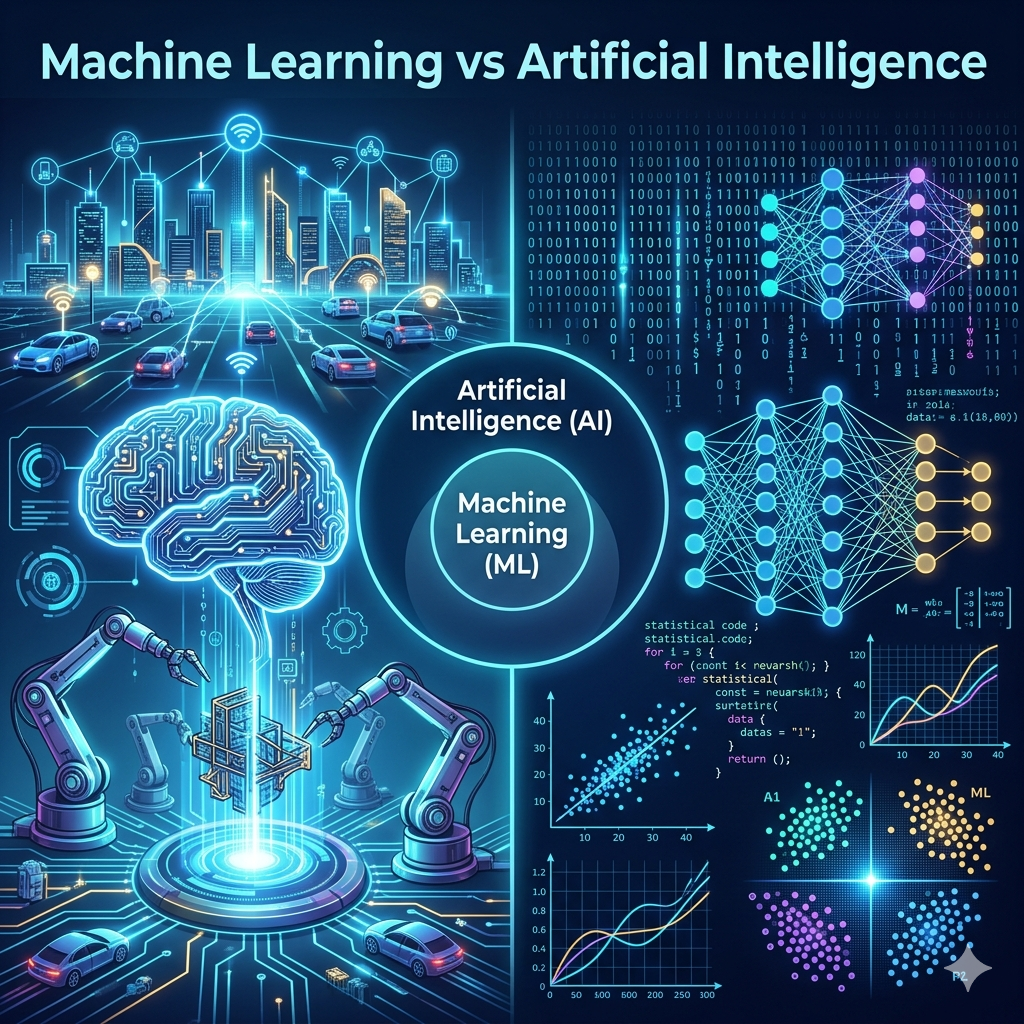
In simple terms, Artificial Intelligence is the broader concept of creating machines that can perform tasks that normally require human intelligence. Machine Learning is a subset of AI that focuses on enabling machines to learn from data and improve their performance without being explicitly programmed.
This article explores the key differences, similarities, applications, benefits, challenges, and future of Machine Learning and Artificial Intelligence.
What is Artificial Intelligence?
Artificial Intelligence refers to the ability of machines and computer systems to mimic human intelligence.
AI systems are designed to:
- Learn from information
- Solve problems
- Make decisions
- Understand language
- Recognize patterns
- Interact with humans
The goal of AI is to create machines that can perform intelligent tasks similarly to humans.
Examples of Artificial Intelligence include:
- Voice assistants
- Self-driving cars
- Chatbots
- Recommendation systems
- Facial recognition software
- Robotics
Artificial Intelligence combines multiple technologies to simulate human thinking and behavior.
What is Machine Learning?
Machine Learning is a branch of Artificial Intelligence that focuses on teaching computers how to learn from data.
Instead of following fixed rules, Machine Learning algorithms analyze data, identify patterns, and make predictions based on what they learn.
Machine Learning allows systems to improve automatically through experience.
Examples of Machine Learning include:
- Email spam filters
- Product recommendations
- Fraud detection systems
- Image recognition
- Predictive analytics
Machine Learning helps computers become more accurate over time as they process additional data.
Relationship Between AI and Machine Learning
One of the easiest ways to understand the difference is through a simple comparison:
Artificial Intelligence is the larger field.
Machine Learning is a subset of Artificial Intelligence.
Think of AI as a large circle and Machine Learning as a smaller circle inside it.
Not all AI systems use Machine Learning, but most modern AI applications rely heavily on Machine Learning techniques.
In other words:
- AI is the goal.
- Machine Learning is one method used to achieve that goal.
History of Artificial Intelligence
Artificial Intelligence began in the 1950s when researchers started exploring whether machines could imitate human thinking.
Key milestones include:
1956: Birth of AI
The term “Artificial Intelligence” was officially introduced during the Dartmouth Conference.
1960s and 1970s
Researchers developed rule-based systems capable of solving simple problems.
1980s
Expert systems became popular and helped businesses automate decision-making.
2000s
Increased computing power and internet growth accelerated AI development.
Present Day
Modern AI uses Machine Learning, Deep Learning, and massive datasets to power intelligent applications worldwide.
History of Machine Learning
Machine Learning emerged as a specialized field within Artificial Intelligence.
Early Development
Researchers realized that manually programming every possible scenario was impractical.
Statistical Learning
Scientists began developing algorithms that could learn patterns from data.
Big Data Revolution
The rise of big data and powerful computers allowed Machine Learning models to become highly effective.
Deep Learning Era
Advanced neural networks dramatically improved Machine Learning capabilities.
Today, Machine Learning powers many of the world’s most advanced AI systems.
Key Differences Between AI and Machine Learning
Although they are related, several important differences exist.
Scope
Artificial Intelligence has a broader scope.
Machine Learning is only one branch of AI.
AI includes:
- Machine Learning
- Deep Learning
- Robotics
- Natural Language Processing
- Expert Systems
Machine Learning focuses specifically on learning from data.
Goal
The goal of AI is to create intelligent systems capable of performing human-like tasks.
The goal of Machine Learning is to develop systems that learn automatically and improve over time.
Approach
Artificial Intelligence may use predefined rules, reasoning systems, and learning algorithms.
Machine Learning relies primarily on data and statistical models.
Data Dependency
AI systems may function without large datasets.
Machine Learning requires significant amounts of data to learn effectively.
Complexity
AI often involves combining multiple technologies.
Machine Learning focuses mainly on pattern recognition and prediction.
Types of Artificial Intelligence
Artificial Intelligence can be categorized into several types.
Narrow AI
Narrow AI is designed for specific tasks.
Examples include:
- Voice assistants
- Recommendation engines
- Image recognition software
Most AI systems today fall into this category.
General AI
General AI refers to machines capable of performing any intellectual task that humans can perform.
This type of AI does not yet exist.
Super AI
Super AI is a hypothetical future form of intelligence that surpasses human intelligence.
It remains a theoretical concept.
Types of Machine Learning
Machine Learning is generally divided into three main categories.
Supervised Learning
In supervised learning, algorithms learn from labeled data.
Examples:
- Spam detection
- House price prediction
- Medical diagnosis
Unsupervised Learning
Algorithms analyze unlabeled data to discover hidden patterns.
Examples:
- Customer segmentation
- Market analysis
- Recommendation systems
Reinforcement Learning
Algorithms learn through trial and error using rewards and penalties.
Examples:
- Robotics
- Game-playing AI
- Autonomous vehicles
How Artificial Intelligence Works
Artificial Intelligence combines various technologies.
These may include:
- Machine Learning
- Natural Language Processing
- Computer Vision
- Knowledge Representation
- Expert Systems
AI systems gather information, analyze it, make decisions, and perform actions.
Many AI systems incorporate Machine Learning to improve performance over time.
How Machine Learning Works
Machine Learning follows a structured process.
Data Collection
Algorithms require large amounts of data.
Data Preparation
Data is cleaned and organized.
Training
The model learns patterns from training data.
Testing
Performance is evaluated using new data.
Deployment
The trained model is used in real-world applications.
As new data becomes available, the model can continue improving.
Real-World Applications of Artificial Intelligence
AI is used across numerous industries.
Healthcare
- Disease diagnosis
- Medical imaging
- Virtual assistants
Finance
- Fraud detection
- Automated trading
- Risk analysis
Transportation
- Self-driving cars
- Traffic optimization
Education
- Personalized learning
- Intelligent tutoring systems
Customer Service
- Chatbots
- Virtual assistants
Artificial Intelligence improves efficiency and decision-making across industries.
Real-World Applications of Machine Learning
Machine Learning powers many everyday technologies.
Recommendation Systems
Platforms suggest products, movies, and videos based on user behavior.
Fraud Detection
Banks identify suspicious transactions using Machine Learning models.
Speech Recognition
Voice assistants use Machine Learning to understand spoken language.
Image Recognition
ML enables systems to identify objects and faces in images.
Predictive Analytics
Businesses forecast trends and customer behavior using Machine Learning.
Benefits of Artificial Intelligence
Artificial Intelligence offers many advantages.
Automation
AI reduces repetitive manual tasks.
Improved Accuracy
AI minimizes human errors.
Faster Decisions
AI processes information quickly.
Increased Productivity
Organizations become more efficient.
Enhanced Customer Experiences
AI enables personalized services.
Benefits of Machine Learning
Machine Learning provides unique advantages.
Continuous Improvement
Models become more accurate over time.
Pattern Discovery
ML identifies hidden trends in data.
Scalability
Machine Learning can analyze massive datasets.
Predictive Capabilities
Businesses can anticipate future outcomes.
Automation of Complex Tasks
ML handles tasks that are difficult to program manually.
Challenges of Artificial Intelligence
Despite its benefits, AI faces challenges.
Ethical Concerns
Questions about fairness and transparency remain important.
Privacy Issues
AI often relies on large amounts of personal data.
Job Displacement
Automation may impact certain job roles.
Security Risks
AI systems can be vulnerable to cyber threats.
Challenges of Machine Learning
Machine Learning also presents challenges.
Data Quality
Poor-quality data leads to inaccurate results.
Bias
Biased training data can produce unfair outcomes.
High Computational Costs
Training advanced models requires significant resources.
Explainability
Some ML models are difficult to interpret.
Organizations must address these issues carefully.
AI vs Machine Learning in Business
Businesses often use both technologies together.
Artificial Intelligence provides overall intelligence and automation.
Machine Learning supplies predictive insights and continuous improvement.
Examples include:
- Customer support automation
- Sales forecasting
- Marketing optimization
- Supply chain management
Companies that leverage both technologies gain competitive advantages.
Future of Artificial Intelligence
The future of AI includes:
- Human-like virtual assistants
- Advanced robotics
- Autonomous transportation
- Smart cities
- Artificial General Intelligence
AI will continue transforming industries and everyday life.
Future of Machine Learning
Machine Learning will become even more powerful as data availability increases.
Future developments may include:
- More accurate predictions
- Faster model training
- Better healthcare diagnostics
- Improved automation
- Enhanced personalization
Machine Learning will remain a core component of future AI systems.
Which is Better: AI or Machine Learning?
This question is similar to asking whether a car or an engine is better.
Machine Learning is part of Artificial Intelligence.
They serve different purposes and work together.
Artificial Intelligence provides the broader vision of intelligent systems.
Machine Learning provides one of the most effective ways to achieve that vision.
Neither is better than the other because they complement each other.
Careers in AI and Machine Learning
These fields offer excellent career opportunities.
Popular roles include:
- Machine Learning Engineer
- AI Research Scientist
- Data Scientist
- Robotics Engineer
- NLP Engineer
- AI Product Manager
Demand for professionals in both fields continues to grow worldwide.
Conclusion
Artificial Intelligence and Machine Learning are closely related but distinct technologies. Artificial Intelligence is the broader concept of creating intelligent machines capable of performing human-like tasks. Machine Learning is a subset of AI that enables systems to learn from data and improve automatically.
AI encompasses many technologies, including robotics, natural language processing, expert systems, and Machine Learning. Meanwhile, Machine Learning focuses specifically on pattern recognition, prediction, and data-driven learning.
Both technologies are revolutionizing industries such as healthcare, finance, education, transportation, and entertainment. Together, they are driving innovation and creating new opportunities for businesses and individuals alike.
Understanding the difference between Machine Learning and Artificial Intelligence is essential in today’s technology-driven world. As these technologies continue to evolve, they will play an even greater role in shaping the future of work, business, and everyday life.