
Introduction
Artificial Intelligence (AI) is no longer a technology of the future. It has become an important part of everyday life and is changing the way people work, communicate, learn, shop, and entertain themselves. Many people use AI daily without even realizing it. From voice assistants and navigation apps to online shopping recommendations and smart home devices, AI is helping make life easier and more efficient.
Artificial Intelligence refers to machines and computer systems that can perform tasks that normally require human intelligence. These tasks include learning, problem-solving, decision-making, understanding language, and recognizing patterns. As technology continues to improve, AI is becoming more advanced and useful in various aspects of daily life.
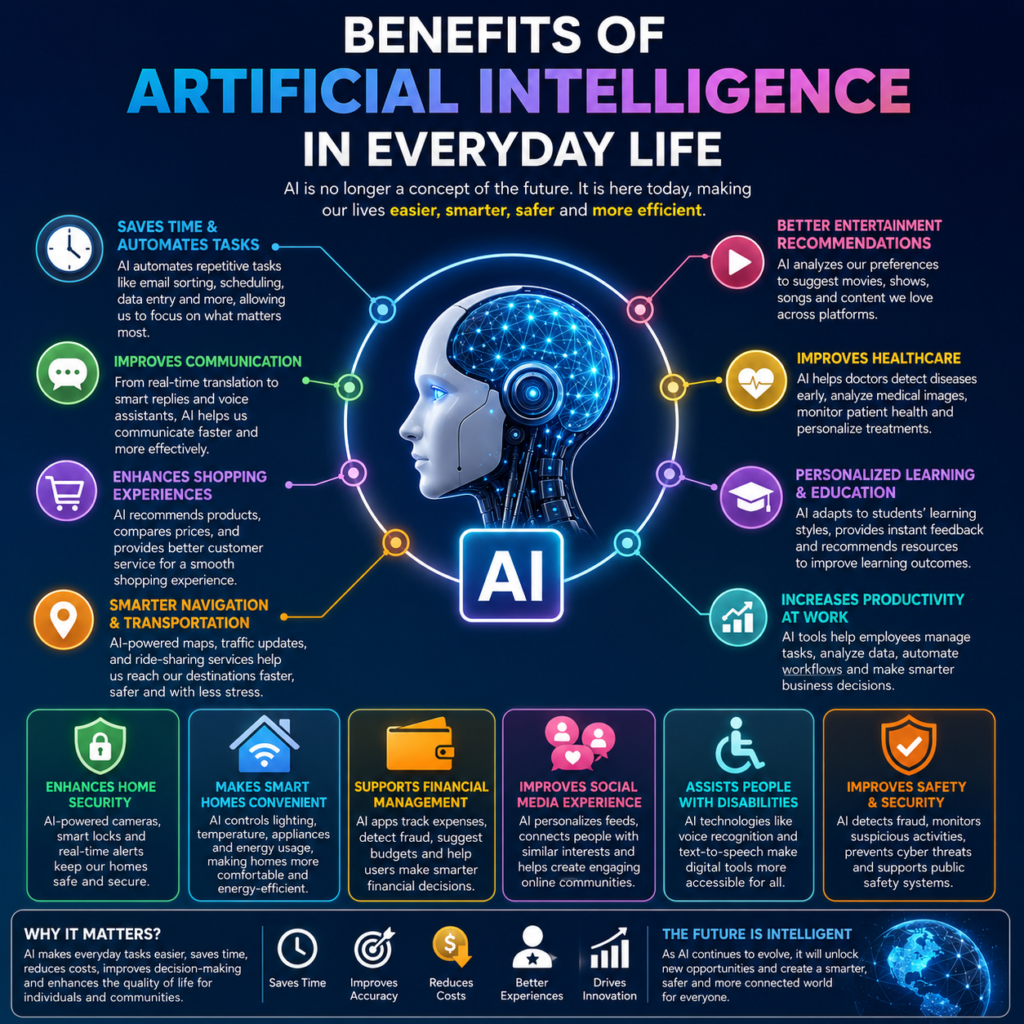
The benefits of Artificial Intelligence extend far beyond businesses and large organizations. Today, AI helps individuals save time, improve productivity, make better decisions, and enjoy more personalized experiences. In this article, we will explore the many benefits of Artificial Intelligence in everyday life and understand how it is transforming the modern world.
What is Artificial Intelligence?
Artificial Intelligence is a branch of computer science focused on creating systems that can perform intelligent tasks. AI systems learn from data, identify patterns, and make decisions with minimal human intervention.
Some common examples of AI include:
- Voice assistants like Siri and Alexa
- Chatbots on websites
- Recommendation systems on YouTube and Netflix
- Facial recognition technology
- Self-driving vehicles
- Smart home devices
These technologies use AI to understand information, process data, and provide useful results to users.
Saving Time Through Automation
One of the biggest benefits of Artificial Intelligence is automation. AI can perform repetitive tasks much faster than humans, allowing people to focus on more important activities.
For example:
- Email services automatically sort spam messages.
- Banking apps process transactions instantly.
- Smart devices automate household tasks.
- Businesses use AI to manage customer support.
Automation reduces the need for manual work and helps people complete tasks more efficiently. Whether it is scheduling appointments or organizing files, AI saves valuable time every day.
Improving Communication
AI has significantly improved communication between people around the world. Modern communication tools use AI to provide better and faster interactions.
Some examples include:
Language Translation
AI-powered translation tools can instantly translate text and speech between different languages. This helps people communicate across language barriers and connect with others globally.
Smart Email Assistance
Many email platforms use AI to suggest responses, correct grammar, and organize messages automatically. This makes communication faster and more professional.
Voice Recognition
Voice assistants can understand spoken commands and perform actions such as sending messages, making calls, or searching for information online.
These innovations make communication easier, faster, and more accessible.
Enhancing Online Shopping Experiences
Artificial Intelligence has transformed online shopping by creating personalized experiences for customers.
When users browse online stores, AI analyzes their preferences, browsing history, and previous purchases. Based on this information, it recommends products that match their interests.
Benefits include:
- Personalized product recommendations
- Faster product searches
- Better customer service through chatbots
- Improved shopping experiences
As a result, customers can find products more quickly while businesses increase customer satisfaction.
Better Entertainment Recommendations
Entertainment platforms rely heavily on Artificial Intelligence to improve user experiences.
Streaming services analyze viewing habits and suggest movies, TV shows, and videos that users are likely to enjoy. Music platforms recommend songs and playlists based on listening history.
Advantages include:
- Personalized content suggestions
- Improved user satisfaction
- Discovery of new content
- Better engagement with platforms
Instead of spending time searching for content, users receive recommendations tailored to their interests.
Smarter Navigation and Transportation
AI has revolutionized transportation and navigation systems.
Navigation apps use Artificial Intelligence to analyze traffic conditions, road closures, and travel patterns. They provide real-time route suggestions that help users reach destinations faster.
Benefits include:
- Reduced travel time
- Accurate traffic updates
- Improved route planning
- Lower fuel consumption
Ride-sharing services also use AI to match drivers with passengers efficiently and optimize routes for faster service.
Improving Healthcare Services
Healthcare is one of the industries benefiting most from Artificial Intelligence.
AI helps doctors and medical professionals diagnose diseases, analyze medical images, and monitor patient health more accurately.
Some applications include:
Early Disease Detection
AI systems can identify signs of diseases such as cancer and heart conditions earlier than traditional methods.
Medical Imaging
Advanced AI tools analyze X-rays, MRIs, and CT scans to assist doctors in detecting abnormalities.
Virtual Health Assistants
AI-powered health assistants can answer medical questions, remind patients to take medication, and monitor health conditions.
These innovations improve healthcare quality while helping patients receive better treatment.
Personalized Education and Learning
Artificial Intelligence is making education more effective and accessible.
AI-powered learning platforms can adapt lessons based on a student’s progress and learning style. This personalized approach helps students learn more efficiently.
Benefits include:
- Customized learning experiences
- Instant feedback on assignments
- Improved student engagement
- Better educational outcomes
Online learning platforms use AI to recommend courses and learning materials tailored to individual needs.
Increasing Workplace Productivity
AI is helping employees become more productive by automating routine tasks and providing intelligent assistance.
Examples include:
- Scheduling meetings automatically
- Managing emails
- Organizing documents
- Analyzing large datasets
Employees can focus on creative and strategic work instead of spending time on repetitive activities.
Businesses benefit from increased efficiency, reduced costs, and improved performance.
Improving Customer Service
Many companies use AI-powered chatbots and virtual assistants to provide customer support.
These systems can:
- Answer common questions
- Resolve simple issues
- Process requests
- Provide support 24/7
Benefits for customers include faster response times and immediate assistance without waiting for human representatives.
For businesses, AI customer service reduces operational costs while improving customer satisfaction.
Enhancing Home Security
Smart home security systems use Artificial Intelligence to provide better protection.
AI-powered cameras can:
- Detect unusual activity
- Recognize faces
- Send real-time alerts
- Monitor homes remotely
Homeowners can receive instant notifications when suspicious activity is detected, improving overall safety and security.
Making Smart Homes More Convenient
AI plays a major role in modern smart homes.
Smart devices can learn user preferences and automate household functions such as:
- Adjusting room temperatures
- Controlling lighting
- Managing security systems
- Playing music
- Operating appliances
These features increase comfort while reducing energy consumption and utility costs.
Supporting Financial Management
Artificial Intelligence helps individuals manage their finances more effectively.
Many banking and financial apps use AI to:
- Track spending habits
- Create budgets
- Detect fraud
- Provide investment recommendations
Users gain better insights into their financial behavior and can make smarter financial decisions.
Fraud detection systems also help protect customers from unauthorized transactions and cybercrime.
Improving Social Media Experiences
Social media platforms use AI to personalize user experiences.
AI algorithms analyze user behavior and recommend:
- Posts
- Videos
- Friends
- Groups
- Advertisements
This creates more engaging and relevant content for users.
AI also helps identify harmful content, reduce spam, and improve platform safety.
Assisting People with Disabilities
Artificial Intelligence is improving accessibility for people with disabilities.
Examples include:
Speech Recognition
Voice-controlled systems help individuals who have difficulty using traditional devices.
Text-to-Speech Technology
AI converts written text into spoken words for visually impaired users.
Real-Time Captioning
AI-generated captions help individuals with hearing impairments understand audio content.
These technologies promote greater independence and inclusion.
Improving Safety and Security
AI contributes significantly to public safety and cybersecurity.
Applications include:
- Fraud detection
- Cyber threat monitoring
- Surveillance systems
- Emergency response systems
AI can identify suspicious activities faster than humans and help prevent security breaches before they cause damage.
As cyber threats continue to grow, AI plays an increasingly important role in protecting digital systems.
Helping Businesses Grow
Businesses of all sizes benefit from Artificial Intelligence.
AI helps companies:
- Understand customer behavior
- Predict market trends
- Improve marketing campaigns
- Optimize operations
These capabilities allow businesses to make data-driven decisions and remain competitive in rapidly changing markets.
Small businesses can also leverage AI tools to compete more effectively with larger organizations.
Environmental Benefits of AI
Artificial Intelligence is contributing to environmental sustainability.
AI helps organizations:
- Reduce energy consumption
- Monitor pollution levels
- Optimize resource usage
- Improve waste management
Smart energy systems use AI to balance electricity demand and reduce waste, helping create a more sustainable future.
Faster and Better Decision-Making
AI systems can analyze massive amounts of data within seconds.
This enables individuals and organizations to make informed decisions quickly.
Examples include:
- Financial investments
- Medical diagnoses
- Business strategies
- Traffic management
Faster decision-making leads to better outcomes and increased efficiency.
Reducing Human Errors
Humans naturally make mistakes, especially when performing repetitive tasks.
AI systems can execute tasks consistently and accurately, reducing errors in areas such as:
- Data entry
- Manufacturing
- Financial transactions
- Medical analysis
Improved accuracy leads to higher quality results and better reliability.
The Future of AI in Everyday Life
The role of Artificial Intelligence in everyday life will continue to expand.
Future developments may include:
- More advanced virtual assistants
- Smarter homes and cities
- Autonomous transportation
- AI-powered healthcare breakthroughs
- Enhanced educational experiences
As technology evolves, AI will become even more integrated into daily activities, making life more convenient, productive, and connected.
Conclusion
Artificial Intelligence has become one of the most transformative technologies of the modern era. It affects nearly every aspect of everyday life, from communication and entertainment to healthcare, education, transportation, and finance.
The benefits of Artificial Intelligence include increased efficiency, improved decision-making, enhanced convenience, personalized experiences, and greater accessibility. AI helps individuals save time, reduce effort, and accomplish tasks more effectively than ever before.
As AI technology continues to advance, its impact on society will only grow stronger. Understanding and embracing Artificial Intelligence today can help individuals and businesses prepare for a future where intelligent systems play an even larger role in daily life.
Artificial Intelligence is not just shaping the future—it is already improving the present.