
Introduction
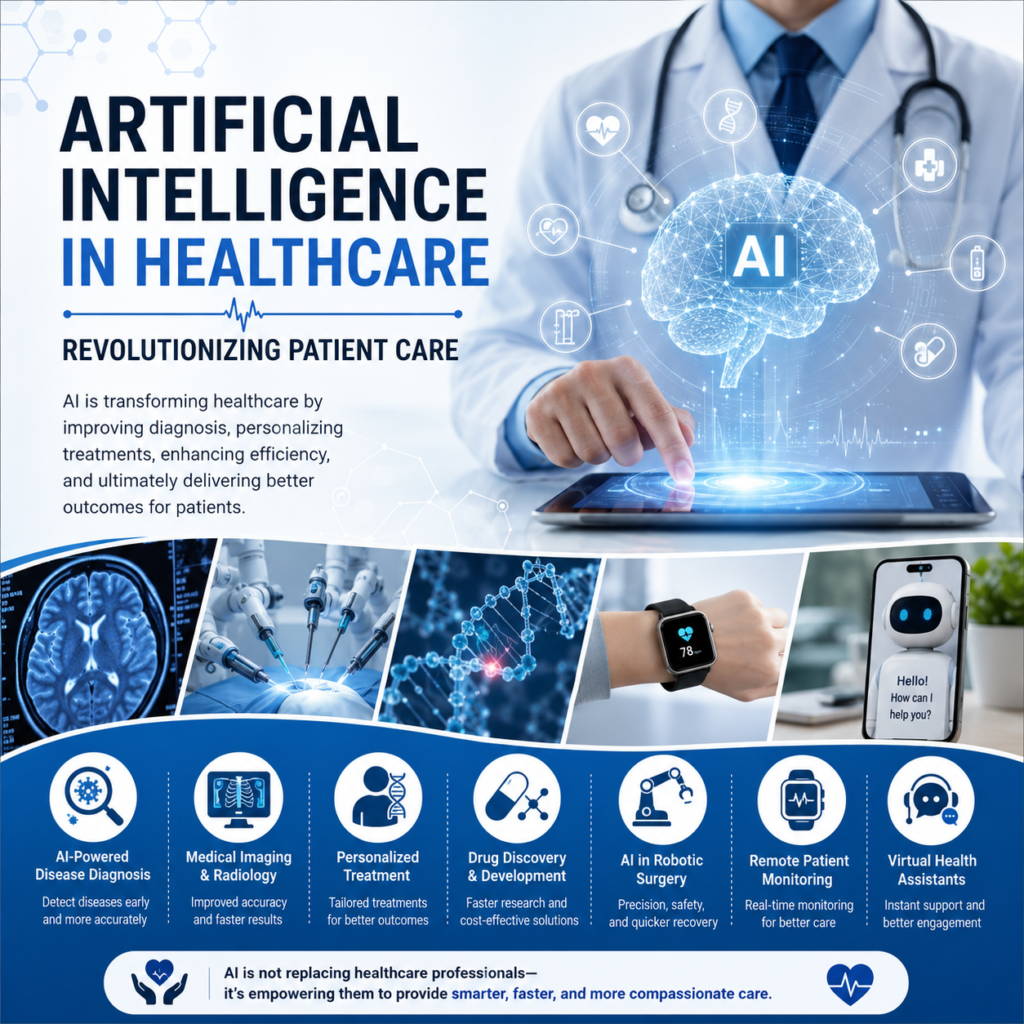
Artificial Intelligence (AI) is transforming industries around the world, and healthcare is one of the sectors experiencing the most significant changes. From diagnosing diseases to assisting in surgeries, AI is helping medical professionals deliver faster, more accurate, and more personalized care to patients. As healthcare systems face growing challenges such as rising costs, increasing patient populations, and shortages of medical staff, Artificial Intelligence offers innovative solutions that can improve efficiency and patient outcomes.
AI in healthcare refers to the use of intelligent computer systems that can analyze data, recognize patterns, learn from experience, and assist healthcare providers in making better decisions. These technologies are revolutionizing patient care by enhancing diagnosis, treatment planning, disease prevention, and overall healthcare management.
In this article, we will explore how Artificial Intelligence is revolutionizing healthcare, its benefits, applications, challenges, and what the future holds for AI-powered patient care.
What is Artificial Intelligence in Healthcare?
Artificial Intelligence in healthcare involves the use of advanced algorithms, machine learning, deep learning, and data analytics to perform tasks that typically require human intelligence.
AI systems can:
- Analyze medical records
- Detect diseases
- Predict health risks
- Recommend treatments
- Assist healthcare professionals
- Monitor patient health
Unlike traditional software, AI continuously learns from data and improves its performance over time, making it a valuable tool for modern healthcare.
The Growing Importance of AI in Healthcare
Healthcare generates massive amounts of data every day. This includes patient records, medical images, laboratory reports, prescriptions, and research studies. Managing and analyzing such large volumes of information manually is challenging.
Artificial Intelligence helps healthcare organizations process this data quickly and accurately. By identifying patterns that humans may overlook, AI supports better decision-making and improves patient care.
As technology advances, AI is becoming an essential component of healthcare systems worldwide.
AI-Powered Disease Diagnosis
One of the most impactful applications of Artificial Intelligence is disease diagnosis.
AI algorithms can analyze symptoms, medical histories, laboratory results, and imaging scans to help identify diseases at an early stage.
Early Detection of Cancer
AI-powered systems can examine medical images such as mammograms, CT scans, and MRIs to detect signs of cancer. In many cases, AI can identify abnormalities that might be difficult for humans to detect.
Early diagnosis increases the chances of successful treatment and improves patient survival rates.
Heart Disease Detection
AI can analyze heart scans, blood test results, and patient records to identify individuals at risk of cardiovascular diseases.
Healthcare providers can then take preventive measures before serious complications occur.
Neurological Disorders
AI is also being used to detect neurological conditions such as Alzheimer’s disease, Parkinson’s disease, and multiple sclerosis through advanced image analysis and pattern recognition.
Medical Imaging and Radiology
Radiology is one of the fields most transformed by Artificial Intelligence.
Medical imaging generates vast amounts of visual data that require careful analysis. AI assists radiologists by identifying abnormalities and highlighting areas that require attention.
Applications include:
- X-ray analysis
- MRI interpretation
- CT scan evaluation
- Ultrasound imaging
AI improves accuracy, reduces diagnostic errors, and speeds up image interpretation, allowing healthcare professionals to focus on patient care.
Personalized Treatment Plans
Every patient is unique, and treatments that work for one individual may not be effective for another.
Artificial Intelligence helps create personalized treatment plans by analyzing:
- Medical history
- Genetic information
- Lifestyle factors
- Current health conditions
Using this data, AI can recommend treatments that are most likely to produce positive outcomes for specific patients.
Personalized medicine leads to more effective treatments and fewer side effects.
Drug Discovery and Development
Developing new medications is a complex and expensive process that can take many years.
Artificial Intelligence is accelerating drug discovery by:
- Identifying potential drug candidates
- Predicting drug effectiveness
- Reducing research costs
- Analyzing biological data
AI can evaluate millions of chemical compounds in a fraction of the time required by traditional methods.
This speeds up the development of life-saving medications and helps pharmaceutical companies bring treatments to market faster.
AI in Robotic Surgery
Robotic-assisted surgery is another major advancement powered by Artificial Intelligence.
AI-enabled surgical systems help surgeons perform procedures with greater precision and control.
Benefits include:
- Smaller incisions
- Reduced blood loss
- Faster recovery times
- Lower risk of complications
- Improved surgical accuracy
While surgeons remain in control, AI provides valuable assistance during complex operations.
Virtual Health Assistants
AI-powered virtual health assistants are becoming increasingly popular.
These digital assistants can:
- Answer medical questions
- Schedule appointments
- Remind patients to take medications
- Provide health information
- Monitor symptoms
Patients receive immediate support without needing to visit a healthcare facility for routine inquiries.
Virtual assistants improve patient engagement and help reduce the workload of healthcare professionals.
Remote Patient Monitoring
Artificial Intelligence is enabling continuous patient monitoring through wearable devices and smart health technologies.
Examples include:
- Smartwatches
- Fitness trackers
- Heart monitors
- Glucose monitoring systems
These devices collect health data in real time and use AI to identify potential issues.
Healthcare providers can monitor patients remotely and intervene before conditions worsen.
This is especially valuable for individuals with chronic illnesses such as diabetes, hypertension, and heart disease.
Improving Hospital Operations
AI is not only improving patient care but also enhancing healthcare administration.
Hospitals use AI to optimize operations by:
- Managing patient schedules
- Predicting patient admissions
- Allocating resources efficiently
- Reducing wait times
- Streamlining workflows
Improved operational efficiency allows healthcare facilities to provide better services while reducing costs.
Predictive Analytics in Healthcare
Predictive analytics is one of the most powerful applications of Artificial Intelligence.
AI can analyze large datasets to forecast future health outcomes.
Examples include:
- Predicting disease outbreaks
- Identifying high-risk patients
- Forecasting hospital demand
- Preventing readmissions
Healthcare providers can take preventive measures based on these predictions, improving patient outcomes and reducing healthcare costs.
AI in Mental Health Care
Mental health is another area benefiting from Artificial Intelligence.
AI-powered tools can:
- Detect signs of depression
- Monitor emotional well-being
- Provide mental health support
- Analyze behavioral patterns
Some applications use natural language processing to identify emotional distress through conversations and written communication.
These tools help patients receive support earlier and improve access to mental health services.
Enhancing Patient Experience
Patient satisfaction is a critical aspect of healthcare.
Artificial Intelligence improves patient experiences through:
- Faster appointment scheduling
- Reduced waiting times
- Personalized communication
- Efficient treatment recommendations
Patients receive more convenient and responsive healthcare services, leading to greater trust and satisfaction.
AI in Emergency Care
Emergency departments often operate under high pressure and require rapid decision-making.
AI assists emergency care providers by:
- Prioritizing critical patients
- Analyzing symptoms quickly
- Supporting diagnosis
- Predicting patient deterioration
These capabilities help healthcare teams respond more effectively during emergencies.
Benefits of Artificial Intelligence in Healthcare
The advantages of AI in healthcare are extensive.
Improved Accuracy
AI systems can analyze large amounts of medical data with remarkable precision, reducing errors and improving diagnosis.
Faster Decision-Making
Healthcare professionals can access AI-generated insights quickly, enabling faster treatment decisions.
Reduced Healthcare Costs
Automation and improved efficiency help lower operational expenses for healthcare organizations.
Better Patient Outcomes
Early diagnosis and personalized treatments contribute to improved health outcomes.
Increased Efficiency
AI automates routine tasks, allowing healthcare professionals to focus more on patient care.
Enhanced Accessibility
Virtual assistants and remote monitoring technologies make healthcare more accessible to patients regardless of location.
Challenges of AI in Healthcare
Despite its many benefits, AI also presents several challenges.
Data Privacy and Security
Healthcare data is highly sensitive. Protecting patient information from cyber threats and unauthorized access is essential.
Bias in AI Systems
If AI models are trained on biased data, they may produce unfair or inaccurate results for certain populations.
Regulatory Compliance
Healthcare organizations must comply with strict regulations regarding patient safety and data protection.
High Implementation Costs
Developing and deploying AI systems often requires significant investments in technology and infrastructure.
Trust and Adoption
Some healthcare professionals and patients may be hesitant to rely on AI systems for critical medical decisions.
Addressing these challenges is essential for the responsible use of AI in healthcare.
Ethical Considerations
Ethical AI development is critical in healthcare.
Healthcare organizations must ensure:
- Transparency in AI decision-making
- Fair treatment of all patients
- Protection of patient privacy
- Human oversight of AI systems
- Accountability for AI-generated recommendations
Ethical guidelines help ensure that AI benefits patients while minimizing risks.
Future of AI in Healthcare
The future of Artificial Intelligence in healthcare is incredibly promising.
Experts predict continued advancements in:
Precision Medicine
AI will create highly personalized treatment plans based on genetics and individual health profiles.
Autonomous Diagnostics
Future AI systems may independently diagnose diseases with exceptional accuracy.
Advanced Robotics
Surgical robots will become even more precise and capable.
Predictive Healthcare
AI will identify health risks before symptoms appear, allowing preventive interventions.
Global Healthcare Access
AI-powered telemedicine solutions will expand healthcare access to underserved populations worldwide.
These developments have the potential to transform healthcare on a global scale.
Careers in AI Healthcare
The growing adoption of AI is creating new career opportunities.
Popular roles include:
- Healthcare Data Scientist
- AI Research Scientist
- Medical AI Engineer
- Clinical Informatics Specialist
- Healthcare Technology Consultant
- Machine Learning Engineer
These careers offer strong growth potential and competitive salaries.
Conclusion
Artificial Intelligence is revolutionizing healthcare by improving diagnosis, treatment, patient monitoring, and healthcare management. From detecting diseases earlier to enabling personalized medicine and robotic surgery, AI is transforming how healthcare is delivered.
The benefits of Artificial Intelligence in healthcare include greater accuracy, faster decision-making, reduced costs, enhanced efficiency, and improved patient outcomes. While challenges such as data privacy, bias, and regulatory concerns remain, ongoing advancements continue to address these issues.
As technology evolves, AI will play an increasingly important role in shaping the future of medicine. Healthcare providers, researchers, and patients alike stand to benefit from a world where intelligent systems support better care, improved accessibility, and healthier lives.
Artificial Intelligence is not replacing healthcare professionals—it is empowering them to deliver safer, smarter, and more effective patient care than ever before.