
Introduction to AI Development
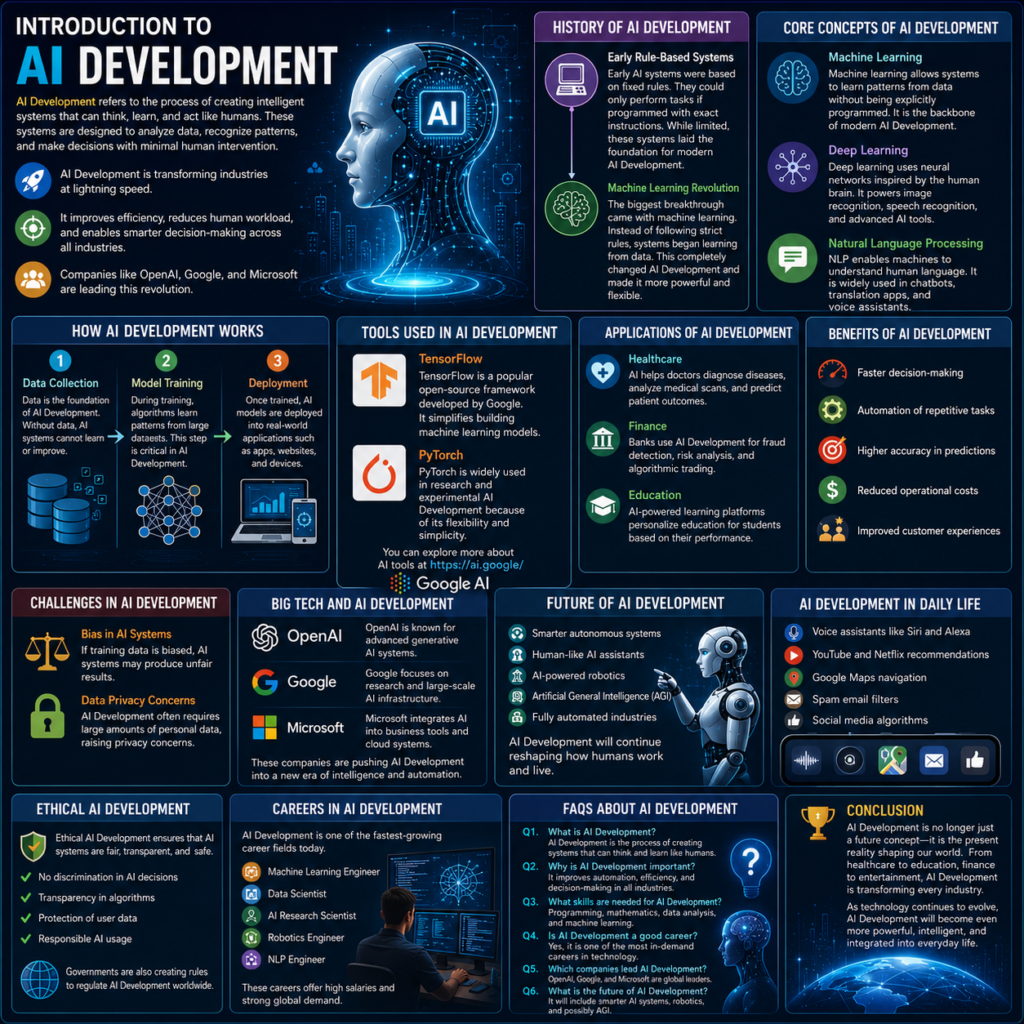
AI Development refers to the process of creating intelligent systems that can think, learn, and act like humans. These systems are designed to analyze data, recognize patterns, and make decisions with minimal human intervention.
Today, AI Development is transforming industries at lightning speed. From mobile apps to self-driving cars, artificial intelligence is everywhere. Companies like OpenAI, Google, and Microsoft are leading this revolution.
AI Development is important because it improves efficiency, reduces human workload, and enables smarter decision-making across all industries.
History of AI Development
The journey of AI Development began in the mid-20th century when scientists first tried to create machines that could mimic human thinking.
Early Rule-Based Systems
Early AI systems were based on fixed rules. They could only perform tasks if programmed with exact instructions. While limited, these systems laid the foundation for modern AI Development.
Machine Learning Revolution
The biggest breakthrough came with machine learning. Instead of following strict rules, systems began learning from data. This completely changed AI Development and made it more powerful and flexible.
Core Concepts of AI Development
AI Development is built on three major pillars:
Machine Learning
Machine learning allows systems to learn patterns from data without being explicitly programmed. It is the backbone of modern AI Development.
Deep Learning
Deep learning uses neural networks inspired by the human brain. It powers image recognition, speech recognition, and advanced AI tools.
Natural Language Processing
NLP enables machines to understand human language. It is widely used in chatbots, translation apps, and voice assistants.
How AI Development Works
AI Development follows a structured lifecycle that ensures accuracy and performance.
Data Collection
Data is the foundation of AI Development. Without data, AI systems cannot learn or improve.
Model Training
During training, algorithms learn patterns from large datasets. This step is critical in AI Development.
Deployment
Once trained, AI models are deployed into real-world applications such as apps, websites, and devices.
Tools Used in AI Development
Modern AI Development depends on powerful tools and frameworks.
TensorFlow
TensorFlow is a popular open-source framework developed by Google. It simplifies building machine learning models.
PyTorch
PyTorch is widely used in research and experimental AI Development because of its flexibility and simplicity.
You can explore more about AI tools at https://ai.google/ Google AI
Applications of AI Development
AI Development is used in almost every industry today.
Healthcare
AI helps doctors diagnose diseases, analyze medical scans, and predict patient outcomes.
Finance
Banks use AI Development for fraud detection, risk analysis, and algorithmic trading.
Education
AI-powered learning platforms personalize education for students based on their performance.
Benefits of AI Development
AI Development offers many powerful advantages:
- Faster decision-making
- Automation of repetitive tasks
- Higher accuracy in predictions
- Reduced operational costs
- Improved customer experiences
Businesses that invest in AI Development gain a strong competitive advantage.
Challenges in AI Development
Despite its benefits, AI Development also faces serious challenges.
Bias in AI Systems
If training data is biased, AI systems may produce unfair results.
Data Privacy Concerns
AI Development often requires large amounts of personal data, raising privacy concerns.
Big Tech and AI Development
Major technology companies are shaping the future of AI Development.
OpenAI is known for advanced generative AI systems.
Google focuses on research and large-scale AI infrastructure.
Microsoft integrates AI into business tools and cloud systems.
These companies are pushing AI Development into a new era of intelligence and automation.
Future of AI Development
The future of AI Development is extremely exciting.
Experts predict:
- Smarter autonomous systems
- Human-like AI assistants
- AI-powered robotics
- Artificial General Intelligence (AGI)
- Fully automated industries
AI Development will continue reshaping how humans work and live.
AI Development in Daily Life
You already use AI Development every day without realizing it:
- Voice assistants like Siri and Alexa
- YouTube and Netflix recommendations
- Google Maps navigation
- Spam email filters
- Social media algorithms
AI Development is deeply integrated into modern life.
Ethical AI Development
Ethical AI Development ensures that AI systems are fair, transparent, and safe.
Developers must ensure:
- No discrimination in AI decisions
- Transparency in algorithms
- Protection of user data
- Responsible AI usage
Governments are also creating rules to regulate AI Development worldwide.
Careers in AI Development
AI Development is one of the fastest-growing career fields today.
Popular job roles include:
- Machine Learning Engineer
- Data Scientist
- AI Research Scientist
- Robotics Engineer
- NLP Engineer
These careers offer high salaries and strong global demand.
FAQs about AI Development
1. What is AI Development?
AI Development is the process of creating systems that can think and learn like humans.
2. Why is AI Development important?
It improves automation, efficiency, and decision-making in all industries.
3. What skills are needed for AI Development?
Programming, mathematics, data analysis, and machine learning.
4. Is AI Development a good career?
Yes, it is one of the most in-demand careers in technology.
5. Which companies lead AI Development?
OpenAI, Google, and Microsoft are global leaders.
6. What is the future of AI Development?
It will include smarter AI systems, robotics, and possibly AGI.
Conclusion
AI Development is no longer just a future concept—it is the present reality shaping our world. From healthcare to education, finance to entertainment, AI Development is transforming every industry.
As technology continues to evolve, AI Development will become even more powerful, intelligent, and integrated into everyday life. Understanding it today means being prepared for tomorrow’s digital world.